Home » Blog » What Information Must Be on a Conference Badge? A Guide to Readability and Function
What Information Must Be on a Conference Badge? A Guide to Readability and Function

Key Points
Include essentials: First name, last name, and company.
Optional enhancements: Job title, pronouns, attendee type, QR codes.
Avoid clutter: Skip contacts, social handles, and long schedules.
Prioritize readability: Use clear hierarchy, high-contrast fonts, and test from a distance.
Conference badges serve a deceptively simple purpose: to help people identify and connect with one another. Yet, achieving this goal requires careful consideration of what information to include, how to present it, and what to deliberately omit. This guide examines the essential elements, optional enhancements, and common mistakes that can compromise readability.
The Primary Purpose of Conference Badges
Badges enable instant identification, facilitating networking. Research indicates that people make networking decisions within 2-3 seconds, based on visual cues. During that brief window, your badge must communicate who someone is and why they matter. Information that doesn’t serve this goal becomes noise. This principle guides the following hierarchy of information.
The Must-Haves: Essential Conference Badge Information
While designs vary, a few core pieces of information are non-negotiable for facilitating effective networking.
First Name
The attendee’s first name is the most critical element. It should dominate the design and be immediately visible from 10 to 15 feet away. This enables others to address the attendee properly and reduces social anxiety.
Best practices include using a font size of 24-36 points, bold weight, high contrast, and placing the text in the upper third of the badge. Never compromise on first name readability.
Last Name
Last names provide essential context and completeness. They help distinguish between attendees with common first names and enable follow-up after events. Last names should appear in 18-24 point font, clearly readable but secondary to the first name.
Company or Organization
The company affiliation gives context that transforms a name into a meaningful connection. In professional settings, knowing where someone works often determines whether to approach them. This element typically appears in a 16-20 point font, positioned below the full name.
The Good-to-Haves: Valuable Optional Information
Once the essentials are covered, these elements can add significant functional or social value if space and clarity permit.
Attendee Type or Role
Color-coding or text indicators that distinguish speakers, exhibitors, sponsors, VIPs, and organizers provide practical value. These indicators help attendees quickly identify whom to approach for specific needs. Implementation options include color-coded borders, small icons, or text labels (“Speaker,” “Sponsor”).
Job Title or Professional Role
Specific titles provide conversation starters. However, job titles can consume limited space and are often lengthy. If including titles, use a 14-18 point font and consider abbreviating standard terms (e.g., VP, Dir., Mgr.).
Pronouns
Displaying pronouns (she/her, he/him, they/them) is an inclusive practice that reduces awkward assumptions and signals organizational respect. Pronouns work best in small, unobtrusive text (12-14 point font) below or next to the name. Make this display optional during registration.
QR Codes
QR codes transform static badges into interactive tools for digital business card exchange, event app profile access, or lead capture. The key is making the QR code’s purpose clear with an adjacent label: “Scan to connect.” Many designs place QR codes on the reverse of the badge to avoid clutter.
Event Branding
The event name, logo, date, and location establish context and serve as a lasting souvenir. Keep event branding subtle. Small logos in the corners or modest event names in 12-14-point font work well. The attendee’s identity should always dominate.
Sponsor Logos
Sponsor logos should never compete with attendee information. Options include small logos at the bottom of the badge, logos on the reverse side, or a single “Presented by [Sponsor]” line.
What to Avoid: Information That Doesn’t Belong
Just as important as what you include is what you leave out. Clutter is the enemy of readability; avoid these common mistakes to enhance readability.
Contact Information (Phone Numbers, Email Addresses)
This information consumes valuable space and raises concerns about privacy. Digital alternatives work better. QR codes can link to digital business cards, or event apps can allow attendees to exchange details electronically.
Social Media Handles
These are difficult to read in small print, add visual clutter, and are not universally relevant. A QR code linking to a page with all social profiles is more effective.
Detailed Event Schedules
Schedules inevitably change after badges are printed, and the small print required is unreadable. Use QR codes linking to live, updated digital schedules instead.
Full Credentials or Certifications
Listing degrees or credentials creates unnecessary hierarchy and consumes space. Exceptions exist for medical or highly technical conferences where roles (MD, RN) provide critical context.
Overly Long Job Titles
Verbose job titles often don’t fit neatly on a badge when they exceed three words; consider abbreviating or simplifying them (e.g., “SVP, Digital Strategy”).
Information Hierarchy and Readability
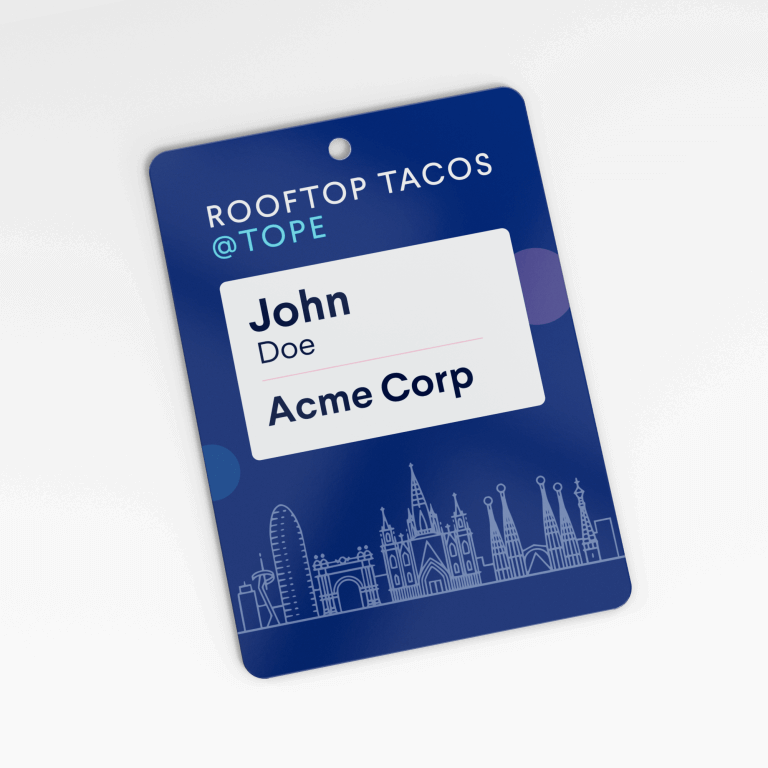
The visual hierarchy should mirror the networking sequence: First name (largest), Last name (secondary), Company (contextual), Additional details.
This hierarchy ensures attendees can quickly gather context for conversation. Information hierarchy and readability are paramount. Several factors ensure it:
- Contrast: Use dark text on light backgrounds or light text on dark backgrounds. The contrast ratio should be high.
- Font Selection: Sans-serif fonts (such as Helvetica, Arial, and Roboto) provide superior readability at a distance. Avoid decorative or script fonts.
- Size Guidelines: Use established minimums: First name 24-36pt, Last name 18-24pt, Company 16-20pt, and Job title 14-18pt.
- Testing: Always print physical samples and test them from 10-15 feet away in lighting similar to your event venue. This is the best way to avoid common printing mistakes.
Testing is essential when choosing new materials. Whether you opt for durable plastic event badges, premium laminated event badges, or modern sustainable conference badges, physical proof is the only way to confirm your design works in the real world.
Special Considerations for Different Event Types
The hierarchy may shift based on your audience:
- Corporate Conferences: Benefit from formal information: full names, clear company affiliations, and appropriate titles.
- Trade show badges: Require clear differentiation of attendee types (e.g., exhibitor, buyer, media) for effective lead generation.
- Academic Conferences: Institutional affiliations often matter more than job titles.
- Networking Events: Should maximize name prominence while minimizing other information that creates barriers.
Modern badges may also integrate technology, such as NFC chips, for digital profile exchange, but these augment, rather than replace, clear visual identification.
Final Thoughts
Conference badge information is an intersection of design and utility. Get it right, and attendees network confidently. Get it wrong, and badges become sources of frustration.
The formula is straightforward: prioritize names, include company context, strategically add role indicators, and ruthlessly eliminate all other information. Test thoroughly and commit to clarity over comprehensiveness.